
Kershaw County Court Records After Arrest
The arrest-to-court path in Kershaw County starts when a person is booked into the Kershaw County Detention Center. That first record is a jail record. It may show the person's name, mugshot field, demographic fields, cell block, arrest date, held-for agency, and release date when those fields are exposed in the public roster. The formal court record is a different record set. It begins to matter most when the charging court process or the Fifth Judicial Circuit Solicitor's Office moves the case forward through filed charges, court dates, amendments, dismissals, pleas, trial entries, or sentencing.
For custody and booking details, use the county roster and booking intake path described in Kershaw County jail inmate records. For booking photos, use the separate Kershaw County jail mugshots resource. Court records after a jail arrest should be checked through the Kershaw Public Index and Court Rosters because those systems track case numbers, parties, charge entries, hearings, and dispositions. A booking charge can differ from the charge a prosecutor later files. A jail release date also does not prove that the court case is over.
Kershaw County Court Records Search
The local court-record starting point is the Kershaw County Clerk of Court's court-records page, which links to the Kershaw County Public Index and the Kershaw County Court Rosters. The South Carolina Judicial Branch also lists Kershaw County on its case records search route as Circuit Number 5, County Number 28. Use the Public Index for case detail and the Court Rosters for scheduled appearances. Neither tool is a live jail-custody roster.
The Kershaw County Public Index screenshot below shows the browser-based interface used for post-arrest court records. It is the local case-search screen to consult after the jail booking record points to a court matter.
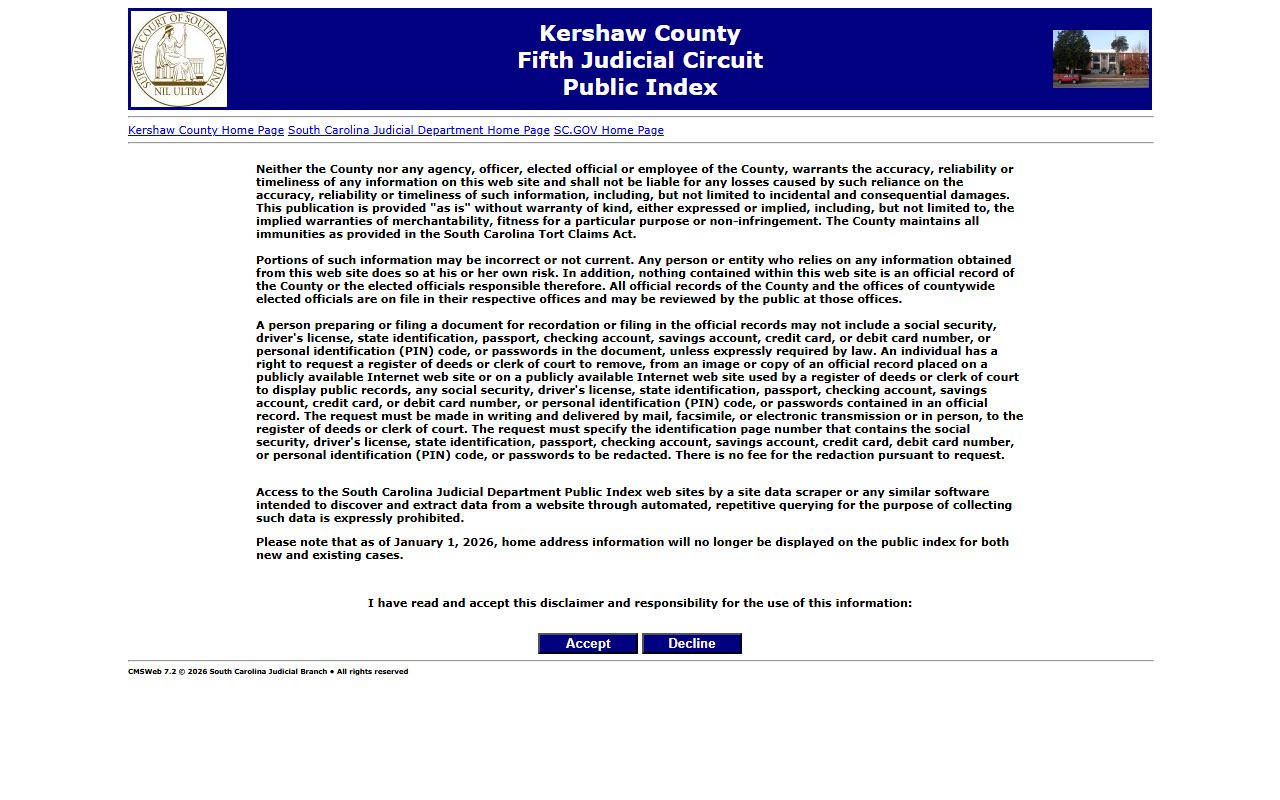
The Public Index is best read with the arrest date, defendant name, or case number close by. If the person was just booked, a court entry may lag behind the jail record, so booking intake can still be the first fallback for bond and custody questions.
| Field | Type | Required | Use in a Post-Arrest Search |
|---|---|---|---|
| County | Route or selection | Yes by route | Kershaw County is listed by the Judicial Branch as Circuit 5, County 28. |
| Case Number | Text | No | Use it when it appears on a notice, bond paper, roster note, or court document. |
| Party or Defendant Name | Text | No | Search by last name and first name, then compare date of birth or case details when shown. |
| Court or Case Type | Filter | No | Availability varies for circuit, magistrate, and municipal records in the Public Index route. |
| Date or Filed Date | Date filter | No | Helpful when the arrest is recent or the name produces many results. |
| Court Rosters | Calendar filters | No | Use for scheduled court activity, not for proof that a person remains in custody. |
Kershaw County Arrest Charge Records
After an arrest, the jail record may list an initial charge or held-for agency. The court record turns on filed papers and court action. South Carolina magistrate and General Sessions practice can involve arrest warrants, preliminary-hearing papers returned to the clerk, solicitor review, indictment, amendments, and disposition entries. The exact label in the Public Index controls. A reader should not assume the booking label is the final charge in court.
| Charging Document | Who Uses It | What It Means | Kershaw County Record Tip |
|---|---|---|---|
| Complaint or warrant-based charge | Law enforcement and charging court process | An accusation tied to the arrest or warrant that may start the court path. | Compare the jail charge with the Public Index entry once the case appears. |
| Information or solicitor-filed charge | Prosecutor | A prosecutor-filed charge or formal filing used to move a case in court. | The Fifth Judicial Circuit Solicitor prosecutes state criminal offenses in Kershaw County. |
| Indictment | Grand jury process | A formal felony charging step for serious cases before General Sessions proceedings. | Indictment or amended-charge entries can differ from the booking wording. |
South Carolina uses solicitors rather than district attorneys. The Fifth Judicial Circuit Solicitor's Office serves Kershaw and Richland Counties, and the South Carolina Judicial Branch identifies the Fifth Circuit as covering both counties. The official solicitor is Byron E. Gipson, and the solicitor's staff page identifies Kershaw County assistant solicitors. The solicitor context matters because the jail does not decide how a criminal case is prosecuted. The court record and prosecutor filings show the case path after arrest.
Kershaw County Court Charge Status
Charge status is the reason a court records search after arrest must go beyond the jail roster. A booking charge may be amended, reduced, dismissed, indicted differently, or marked nolle prosequi. Nolle prosequi means the prosecution will not proceed on that charge at that time. It does not make the original booking record vanish by itself, and it should not be read as a conviction. The Public Index is the better place to check formal status and disposition. The detention center remains the better place to check custody, release, and bond.
| Status | Plain Meaning | How to Read It |
|---|---|---|
| Pending | The charge or case has not reached a final outcome. | Check Court Rosters for scheduled appearances and confirm custody separately if needed. |
| Amended or Reduced | The filed charge changed from the original wording or level. | Use the later court entry for case status, while remembering the jail record may still show the booking charge. |
| Dismissed | The court dismissed the charge or case entry. | Dismissal is not the same as automatic expungement from all public systems. |
| Nolle Prosequi | The prosecution declined to continue that charge. | Read the full docket because other charges or related cases may remain active. |
| Disposition Entered | A plea, verdict, sentence, or other final action was recorded. | Use disposition text for court outcome, not the booking roster. |
Kershaw County Arrest Bond Records
Bond information sits between the jail record and the court record. The Kershaw County family guide gives local bond-hearing rules: city bond hearings are listed at 7:30 AM and 4:30 PM, and county bond hearings are listed at 8:00 AM and 5:00 PM. The guide says all bond hearings are held in the front lobby of the detention center, times are subject to change, and visitors should arrive 15 to 20 minutes before the hearing. Booking and bond questions can be checked through Booking/Intake at 803-425-1516 Option 1 when the online record is incomplete.
| Bond Type | How It Works in Practice | Kershaw County Caution |
|---|---|---|
| Cash bond | Money is posted directly under the court's bond order. | The local guide says only cash can be given to the judge for this type. |
| Surety bond | A licensed bondsman posts paperwork after setting the fee or percentage. | The guide says the bondsman determines the percentage before release paperwork is submitted. |
| Personal recognizance | The court releases the person on a promise to appear. | Confirm conditions in the court order. The jail cannot change them. |
| No-bond hold | No ordinary bond release is available until a judge or holding agency changes the status. | A warrant, probation or parole matter, federal issue, immigration hold, or other agency hold can block release. |
A court record may show bond orders, while the jail record may show whether the person remains in custody. Those facts can differ for valid reasons. A person can satisfy one bond and still remain held on another warrant or detainer. A detainer is a notice that another agency wants custody or notice before release.
Kershaw County Warrants After Arrest
Kershaw County's Zuercher public portal includes a warrant search module tied to local public-safety records for Sheriff Lee Boan's agency and other Kershaw County authorities. The warrant search supports fields such as name, race, sex, date issued, bond amount, and charge. Results may show name, race, sex, date issued, age or date of birth, bond amount, and charge. At least one search criterion may be required by the portal. No separate official most-wanted page was verified in the research sources.
Warrants can explain why an arrest occurred, why a person remains in custody, or why a court case has a new entry. An arrest warrant authorizes an arrest for an alleged offense. A bench warrant is often issued for failure to appear or violation of a court order. A fugitive or hold warrant may mean another jurisdiction wants the person. A search warrant is different because it authorizes a search and is not usually a jail roster item. South Carolina law also addresses municipal warrant service on a person already incarcerated in a county jail or detention center.
Important: A person who believes a Kershaw County warrant exists should contact an attorney, the issuing court, or law enforcement for lawful resolution.
Kershaw County Clerk and Solicitor
Older records, certified copies, and record questions that cannot be answered through the Public Index may require the Kershaw County Clerk of Court. The South Carolina Judicial Branch courthouse page lists Clerk of Court Ginger Farmer, PO Box 1557, Camden, SC 29021-8557, office phone 803-425-7223, and fax 803-425-1505. The Clerk's court-records page is also the local source that points users to the Public Index and Court Rosters.
The solicitor is the prosecutor for serious state criminal cases in the circuit. The Fifth Judicial Circuit Solicitor's Office states that it prosecutes citizens charged with criminal offenses in Richland and Kershaw Counties. That office is the prosecution context for formal charges after arrest, but court dates and docket entries should still be checked in the Public Index and Court Rosters. Victim or custody notifications may also route through VINELink when agency participation makes notice available.
Kershaw County Charges vs Convictions
An arrest and a charge are not the same as a conviction. A charge is an accusation moving through the court process. A conviction requires a guilty plea, verdict, or other final finding that supports judgment. Court records after a jail arrest may show both charged counts and outcomes, so each count should be read on its own. One charge can be dismissed while another remains pending or results in a plea.
| Record Point | Charge | Conviction |
|---|---|---|
| Stage | Accusation after arrest or prosecutor filing. | Final outcome after plea, verdict, or judgment. |
| Proof Level | Based on probable cause or formal charging action. | Requires proof beyond a reasonable doubt or a valid guilty plea. |
| Where It Appears | Jail roster, warrant entry, Public Index, or charging document. | Disposition or sentencing entries in the court record. |
| How to Use It | Do not treat it as guilt. | Still verify the case number, count, and disposition language. |
Kershaw County Sealed or Expunged Records
South Carolina public-access law supports inspection and copying of public records, but exemptions and record-cleanup rules matter. S.C. Code Section 30-4-30 includes public-record access, and subsection (D)(3) addresses documents identifying people confined in a jail, detention center, or prison for the preceding three months. S.C. Code Section 30-4-40 recognizes exemptions that can protect investigative material, privacy-sensitive material, and other restricted records.
| Record Treatment | Sealed | Expunged |
|---|---|---|
| Public Visibility | Hidden or restricted from ordinary public access. | Removed, destroyed, or handled as law directs for eligible records. |
| Agency Access | Some official access may remain under court order or statute. | Access is much narrower and depends on the expungement law and record type. |
| Kershaw County Relevance | Juvenile, sensitive, or ordered-sealed records may not appear like ordinary cases. | Eligible dismissed or resolved matters may require formal expungement steps. |
| Key Law | Public-index visibility depends on court and statutory limits. | S.C. Code Section 17-1-40 addresses expungement and arrest or booking records, including mug shots and fingerprints. |
Expungement is not automatic just because a person was released from jail or a charge was dropped. Section 17-1-40 also includes rules for arrest and booking records and bars certain fee-based mugshot removal practices. If a Kershaw County court record appears sealed, missing, or changed, the Clerk of Court or the attorney of record is the better source than a jail roster screenshot.
Restricted Kershaw County Court Records
Not every post-arrest court record is fully public. Juvenile matters, sealed filings, protected victim information, active investigative material, and privacy-sensitive details may be withheld or redacted. South Carolina FOIA gives access to many public records, yet it also allows exemptions. That balance is why a Public Index search can show less than the whole case file, and why certified or older records may require a direct Clerk of Court request.
Background checks have separate legal rules. Kershaw County court records after arrest may help a person understand public case history, but casual lookup results are not the same as an FCRA-compliant consumer report. Employment, housing, credit, insurance, tenant screening, and other covered decisions require legally compliant sources and procedures.
Important: Kershaw County Inmate Population is not a consumer reporting agency, and information here may not be used for FCRA-covered decisions.